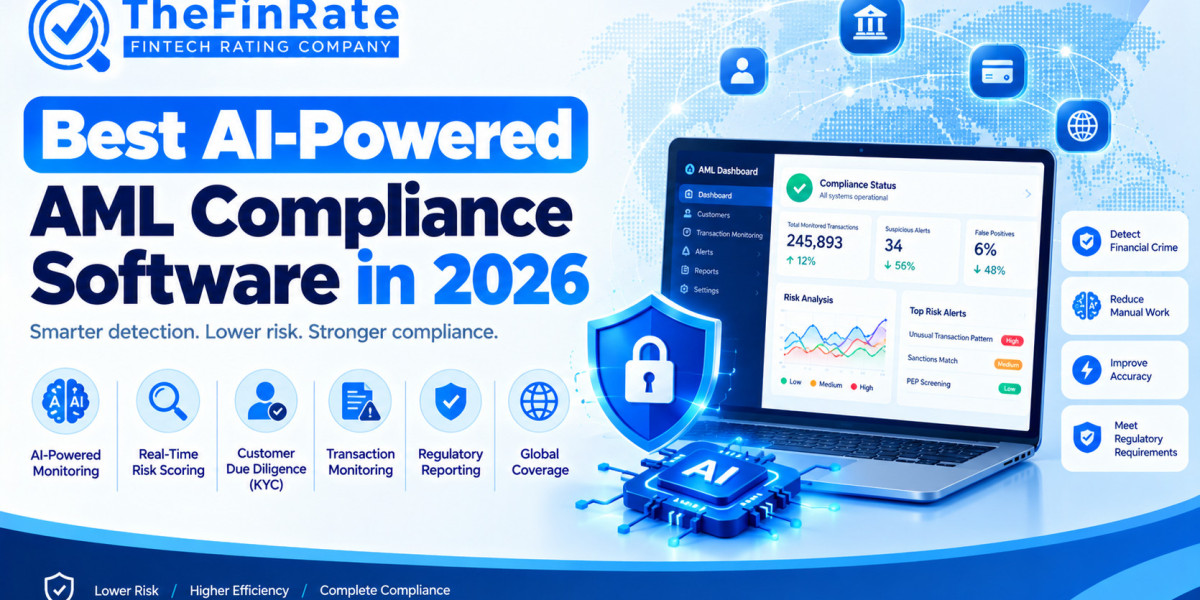

Anti-money laundering (AML) teams are under pressure from two sides. Alert volumes keep climbing, and most of those alerts turn out to be false positives. At the same time, regulators are moving from asking whether you checked a box to asking how you reached each decision. That is why AI-powered AML compliance software is now one of the fastest-moving categories in regtech.
This guide helps you shortlist the right platform. It explains what AI actually does in AML, which capabilities to demand, how leading platforms are positioned, and what the latest news means for buyers. If you work at a payments company or fintech, our overview of payment processing companies shows where AML obligations sit in the wider payments chain.
The short answer: how to choose
There is no single best platform for every firm. The right choice depends on your size, your regulators, and whether your biggest pain is screening, transaction monitoring, case management, or all three.
- Large banks and complex groups: look for enterprise suites with strong case management, model governance, and global regulatory coverage.
- Fintechs, payment firms, and neobanks: look for fast API-led deployment, flexible rules and AI models, and pricing that scales with volume.
- Smaller regulated firms: look for packaged screening and onboarding workflows with minimal engineering effort.
- Anyone facing a regulator exam: prioritize explainability and audit trails over raw detection claims.
What AI actually does in AML software
Vendors use the term "AI" loosely, so it helps to separate the main use cases.
- Smarter transaction monitoring. Machine learning models can score behavior against a customer's normal pattern, which aims to surface genuinely unusual activity and cut the noise generated by static rules.
- Sanctions, PEP, and adverse media screening. AI improves name matching across languages and spellings, which reduces false hits on common names.
- Alert triage and investigation. Newer "agentic" tools gather customer data, check watchlists, review transaction history, and draft a recommendation, leaving the final decision to a human analyst.
- Case narratives and SAR/STR drafting. Generative AI can draft the written narrative for a suspicious activity report, which investigators then review and approve.
- Network and entity analysis. Graph analytics link accounts, people, and companies to reveal hidden relationships and mule networks.
The key point for buyers: AI should shorten the time to a good decision, not hide how the decision was made.
Latest news every AML software buyer should know
Three recent developments show where the market is heading.
1. Starling Bank deploys an AI agent that investigates AML alerts in 17 seconds (October 2026)
UK digital bank Starling has launched an agentic financial crime investigator that receives a transaction-monitoring alert, carries out the investigation, produces the audit trail, and issues a decision, reportedly in about 17 seconds. The agent is built into Starling's core banking engine rather than connected through external integrations. Starling says it expects the future of financial crime compliance to rely on native AI agents instead of larger analyst teams or faster rule engines. Separately, the bank has said it is working with NVIDIA and Civo on a transactional foundation model trained on more than 15 billion anonymized transactions.
What it means for buyers: End-to-end AI investigation is moving from pilot to production. When you evaluate vendors, ask which investigation steps are automated today, which still need an analyst, and how every agent action is logged.
2. The UK FCA is building AI tools to supervise AML compliance across 60,000 firms (October 2026)
The Financial Conduct Authority is developing AI tools to help it supervise how around 60,000 firms comply with AML rules, according to AML Intelligence. The FCA's chief executive, Nikhil Rathi, has also called for an end to "tickbox compliance," arguing that duplicative data packs and assurance processes bog firms down. He said the regulator wants to look beyond KYC to uncover actual money laundering, while noting that KYC, transaction monitoring, and sanctions screening data will remain valuable.
What it means for buyers: Regulators are using AI too, so firms can expect sharper scrutiny of outcomes, not just process. Choose software that demonstrates effectiveness, such as better-quality alerts and clear decision records, rather than software that only generates more paperwork.
3. EU's AMLA sends final customer due diligence standards to the Commission (October 2026)
The EU's Anti-Money Laundering Authority (AMLA) sent its final regulatory technical standards on customer due diligence, linked transactions, and group-wide rules to the European Commission on 1 October 2026, as reported by compliance vendor AI AML. At a London summit in October, AMLA board member Hennie Verbeek-Kusters stressed prevention and the need to join up supervision, FIU cooperation, and risk analysis.
What it means for buyers: If you operate in the EU, check that a vendor's roadmap reflects the new standards and supports consistent group-wide controls.
Best AI-powered AML compliance software in 2026: platforms to shortlist
The platforms below are widely recognized names in AML and financial crime software. The descriptions summarize how each vendor positions itself publicly. Features, pricing, and ownership change often, so confirm current capabilities in a demo before you buy.
Platform | Typically best for | AI angle (as positioned by the vendor) |
|---|---|---|
NICE Actimize | Large banks and complex institutions | Enterprise financial crime suite with AI-assisted monitoring and investigations |
Napier AI | Banks, payment firms, and fintechs wanting explainable models | AI-driven screening and transaction monitoring, with an emphasis on explainability |
SymphonyAI (Sensa-NetReveal) | Institutions seeking AI agents inside investigations | AI agents that assist with data gathering, analysis, and case narratives |
Unit21 | Fintechs and payment companies | No-code rules plus AI agents for alert review and case work |
ComplyAdvantage | Firms prioritizing screening and risk data | AI-enriched sanctions, PEP, and adverse media data with transaction monitoring |
Hawk | Banks and payment firms seeking real-time monitoring | AI-powered transaction monitoring and screening |
Quantexa | Large organizations needing entity resolution | Entity resolution and network analytics for investigations |
Alloy | Onboarding-heavy fintechs and banks | Identity and fraud decisioning that supports KYC workflows |
How the top options differ
NICE Actimize is a long-established enterprise name. It tends to suit large institutions that need a broad suite and have the resources for a more involved implementation. The company has also been engaging the industry on how AI is changing compliance workflows.
Napier AI focuses on AML and financial crime compliance and publishes research on AI adoption among regulators. Its AI/AML Index 2025-2026 looks at which jurisdictions are embedding AI into real AML outcomes, which signals a strong focus on regulator-ready, explainable AI.
SymphonyAI has described AI agents that take over the information-gathering steps of an investigation as soon as a case opens. It reports that agents can cut parts of the process, such as transaction analysis, from many minutes to a few, with every action logged and human oversight built in.
Unit21 is popular with fintechs and payment companies. It has published customer outcomes for AI agents, including a crypto firm that automated 57% of alert reviews and cut false positives by 93%, and a platform that reduced SAR preparation from about a week to under 30 minutes. These are vendor-reported results, so ask for references in your own segment.
ComplyAdvantage, Hawk, Quantexa, and Alloy cover different layers of the stack, from risk data and screening to real-time monitoring, entity resolution, and onboarding decisioning. Many firms combine a screening or onboarding tool with a separate monitoring and case management platform.
Must-have features checklist
Use this list when you build your shortlist and write your RFP.
- Explainability: Can the system show why it raised or cleared an alert, in language an examiner can follow?
- Full audit trail: Is every AI action logged, time-stamped, and reviewable?
- Human-in-the-loop controls: Can analysts review, edit, and override AI recommendations before anything is filed?
- False-positive reduction: Does the vendor share measurable results, and can you test it on your own data?
- Coverage and data quality: Are the sanctions, PEP, and adverse media sources current and relevant to your markets?
- Model governance: Does the vendor support validation, tuning, and change control that your regulator will expect?
- Integration and deployment: Does it connect cleanly to your core systems, and how long does implementation really take?
- Case management and reporting: Does it handle SAR/STR drafting and filing workflows in your jurisdictions?
- Security and data residency: Can data stay in the region you need?
- Total cost: Ask about pricing by volume, modules, and implementation services, not only the license fee.
Common mistakes when buying AML software
- Buying on demo polish instead of results. Insist on a proof of concept using your own historical data.
- Layering AI onto weak foundations. Industry commentary this month warns that firms rushing to add AI to compliance operations never built for it can end up with poor outcomes. Clean data, clear policies, and defined escalation paths come first.
- Ignoring configuration risk. AI cannot fix a screening setup that omits required lists, so test coverage as carefully as detection.
- Underestimating change management. Analysts need training and trust in the tools, or adoption stalls.
How to run your evaluation in five steps
- Define your top three pain points, such as alert volume, onboarding speed, or audit findings.
- Map your regulatory requirements by jurisdiction.
- Shortlist three to five vendors that fit your size and stack.
- Run a proof of concept on real data and measure false positives, time per alert, and explainability.
- Check references from firms like yours, then negotiate contract terms, including exit and data portability.
Frequently asked questions
- What is AI-powered AML compliance software?
It is software that uses machine learning and, increasingly, generative and agentic AI to monitor transactions, screen customers, triage alerts, and help investigators document cases, with the goal of finding real risk faster and with fewer false positives.
- Will AI replace AML analysts?
Not in the near term. Current deployments generally have AI prepare the case while a human reviews and approves decisions, and regulators expect accountability to remain with the firm.
- Do regulators accept AI in AML?
Many are encouraging it, and some are building their own AI tools. What they expect is explainability, strong governance, and evidence that the technology improves outcomes.
- How much does AML software cost?
Pricing varies widely by vendor, modules, and transaction volume. Request detailed quotes and ask what is included in implementation, support, and data fees.
- What is the difference between KYC, AML, and transaction monitoring?
KYC verifies who your customer is, AML is the broader program to prevent money laundering, and transaction monitoring is the ongoing review of customer activity to detect suspicious behavior.
Final thoughts
The best AI-powered AML compliance software in 2026 is the one that helps your team reach defensible decisions faster, with clear evidence behind each one. The latest news, from Starling's 17-second AI investigator to the FCA's shift toward outcomes and AMLA's new standards, points the same way: automation is growing, and so is the expectation of explainability and accountability. Build your shortlist around your risk profile, test vendors on your own data, and keep humans in control of the final call. For more practical guides on payments, compliance, and fees, explore TheFinRate.
Disclaimer: This article is for general informational purposes and is not legal, compliance, or financial advice. Vendor descriptions reflect publicly available positioning and may change. News items are summarized from the cited sources as of October 27, 2026. Always verify current features, pricing, and regulatory requirements directly with vendors and regulators.