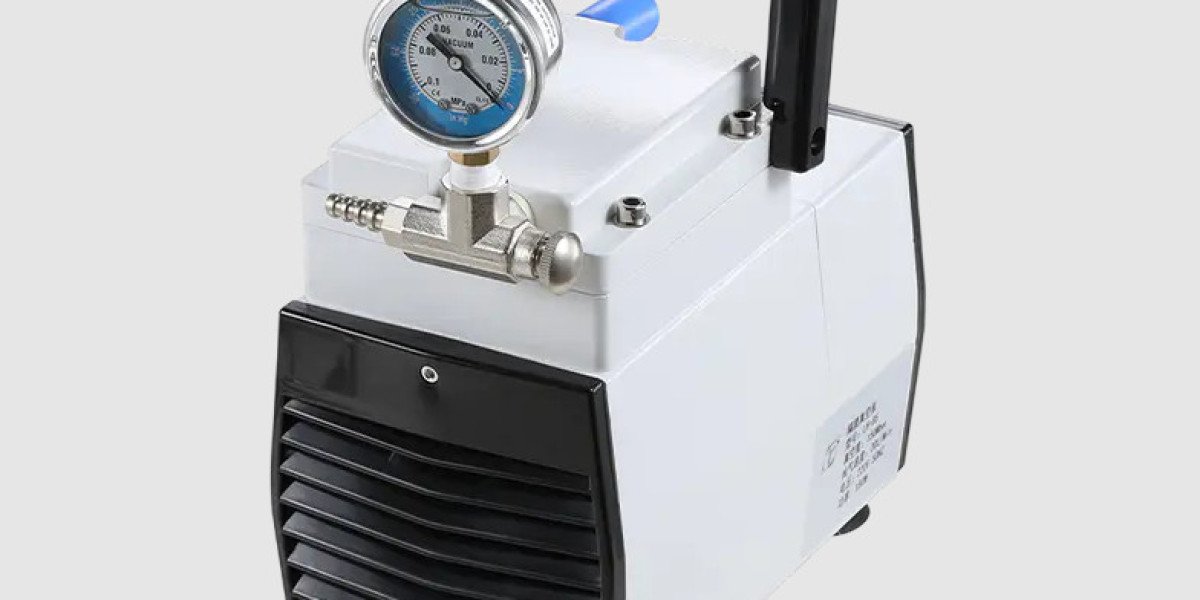

Walk into a modern laboratory, medical facility, or analytical instrumentation room and there's a reasonable chance the vacuum source humming quietly in the corner is an oil-free silent diaphragm vacuum pump. It doesn't announce itself the way older rotary vane pumps did, it doesn't leave an oil mist residue on nearby surfaces, and it doesn't require the maintenance schedule that lubricated pump technologies demand. For environments where cleanliness, noise levels, and operational reliability all matter simultaneously, the diaphragm design has become a genuinely practical answer.
The operating principle of an oil-free silent diaphragm vacuum pump centers on a flexible membrane — the diaphragm — that moves back and forth inside a pumping chamber. As the diaphragm flexes away from the chamber, it creates a pressure differential that draws gas in through an inlet valve. When it moves back toward the chamber, the trapped gas is compressed and pushed out through an exhaust valve. This reciprocating action generates vacuum without any sliding metal surfaces making contact, which is the fundamental reason the pump requires no lubricating oil. The diaphragm material — typically PTFE or a chemically resistant elastomer — handles the mechanical flexing while remaining inert to a wide range of gases and vapors passing through the chamber.
The oil-free nature of the diaphragm vacuum pump carries practical consequences that go beyond simply avoiding oil changes. In applications like rotary evaporation, vacuum filtration, or mass spectrometry sample preparation, even trace oil contamination in the vacuum line can compromise results or damage sensitive instrument components. An oil-free silent diaphragm vacuum pump eliminates that contamination pathway entirely, which is why analytical chemistry and pharmaceutical laboratory environments have adopted it so widely. The vacuum stream remains chemically clean throughout the pump's operating life.
Noise reduction in these pumps comes from several converging design features. The absence of metal-on-metal contact removes one of the primary noise sources in conventional pump designs. Anti-vibration mounts isolate the pump mechanism from the housing and the surface it rests on. Inlet and exhaust silencers reduce the acoustic signature of gas movement through the valves. The combined effect is a pump that operates at sound levels — typically between 40 and 55 decibels depending on model and load — that allow normal conversation in the same room without difficulty, which matters considerably in shared laboratory or clinical spaces.