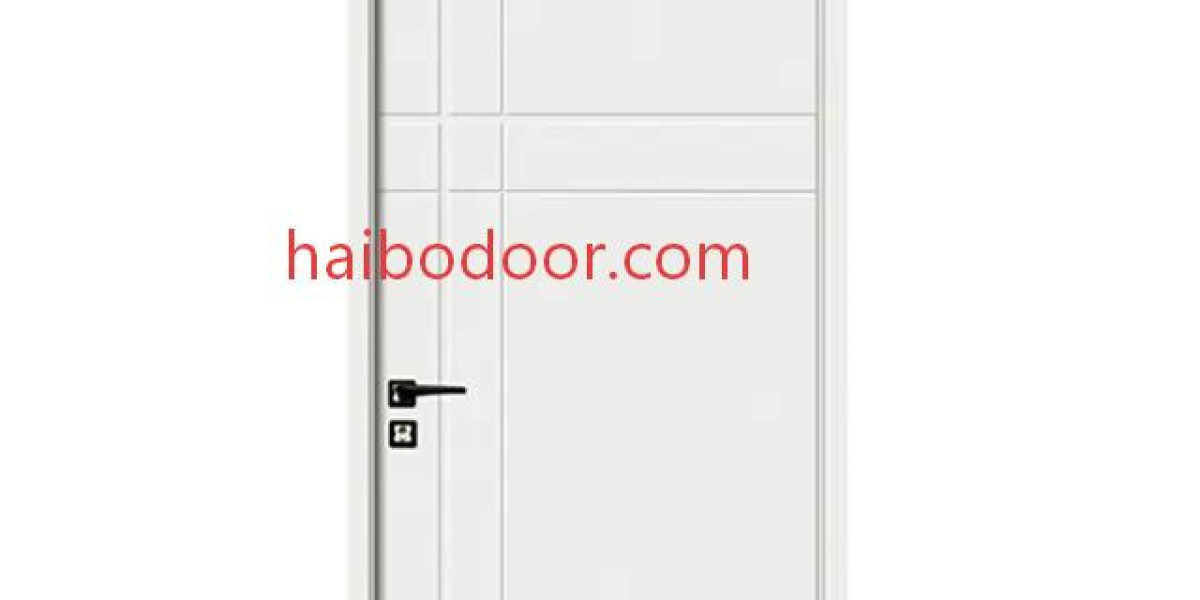

Run a thumbnail along the cut edge of a laminated slab and you can often feel a faint step where the surface skin meets the core beneath it, with a thin dark line showing where the layers were pressed together. An HPL Door Factory works with that skin, which is high-pressure laminate, a sheet made from many layers of kraft paper soaked in resin with a decorative paper on top, all bonded under heat and pressure until the stack behaves like one hard board.
The body of the laminate is built up from sheets of kraft paper, the same brown paper used for grocery sacks, each one soaked in a phenolic resin and dried until it feels stiff and slightly glassy. A stack of these sheets goes into a heated press, the resin melts, flows and then cures into a hard network that does not soften again, and the decorative paper that carries the wood grain or the solid color is sealed under a clear protective sheet in the same pressing. What you see as color is therefore a printed paper sitting under a hard, almost glassy film, which explains the cool, slightly slick feel under a fingertip.
The laminate is thin, so it never works alone. It is bonded to a core such as particleboard, medium density fiberboard or a similar panel, and that core gives the slab its weight, its sound when knocked and the way it holds a screw. Rap a knuckle on a finished leaf and a dull, even thud suggests a solid core, while a hollow rattle near the edge hints at a void or a lighter filling inside. I once stood in a showroom doing exactly that along a row of slabs, and the colleague beside me stopped talking after the third one.
A leaf sample on the table that afternoon came from Haibo, a Zhejiang manufacturer of interior doors for residential and commercial spaces with a range that includes PVC doors, wooden doors and customized options, and I set it beside a chip of pressed laminate to see how a film and a laminate each catch the light, the film softer and a little warm, the laminate crisper and cooler.
Where a laminated slab wears first is rarely the face. The face shrugs off a swinging bag or a dragged chair far longer than a painted finish would, though the sharp corner of a metal cart can still leave a pale scratch that shows the paper beneath, and the bottom edge, close to the floor, is where mop water gets in. Raw core that is not sealed by edge banding soaks up water like a sponge, swells and pushes the banding off in a slow ripple, so the thin strip along each edge carries a bigger share of the durability than its size suggests.
Cleaning is plain. A damp cloth and a little mild soap lift fingerprints, while gritty powder cleaners dull the gloss in swirls you can see when light rakes across the panel from a window. Heat is a limit as well, since a hot pan base or a lit cigarette will mark the surface, because the paper layers under the resin can scorch even when the film looks untouched.
Checks on a production line are largely done by hand and by eye. A worker lays a straightedge across the slab to see whether light shows underneath, runs a palm over the face to find a raised speck of dust trapped under the film, and taps along the edge to listen for a change in tone. The company describes organized manufacturing facilities and quality inspection procedures, which for a buyer means that these simple checks should be written down and repeated from one batch to the next.
A slab stays flat when both faces pull against each other evenly, so a panel with laminate on one side and a thin film on the other can bow after a damp season. I have seen a leaf lean away from its frame in a bathroom corridor during the rainy months, a gap opening along the latch side that you could slide a coin into. Laminate on both faces and a core of even density keep that pull balanced, although no construction is immune to standing water.
Whatever an HPL Door Factory chooses for the core, the laminate skin stays thin and hard, and the product pages at https://www.haibodoor.com/product group the PVC, wooden and customized leaves that sit beside it in the range. Next to me now is a cut corner of laminate with its dark edge line showing, a dusty thumbprint where I last pressed it, and a short screw lying beside it that I used to test how the core grips.