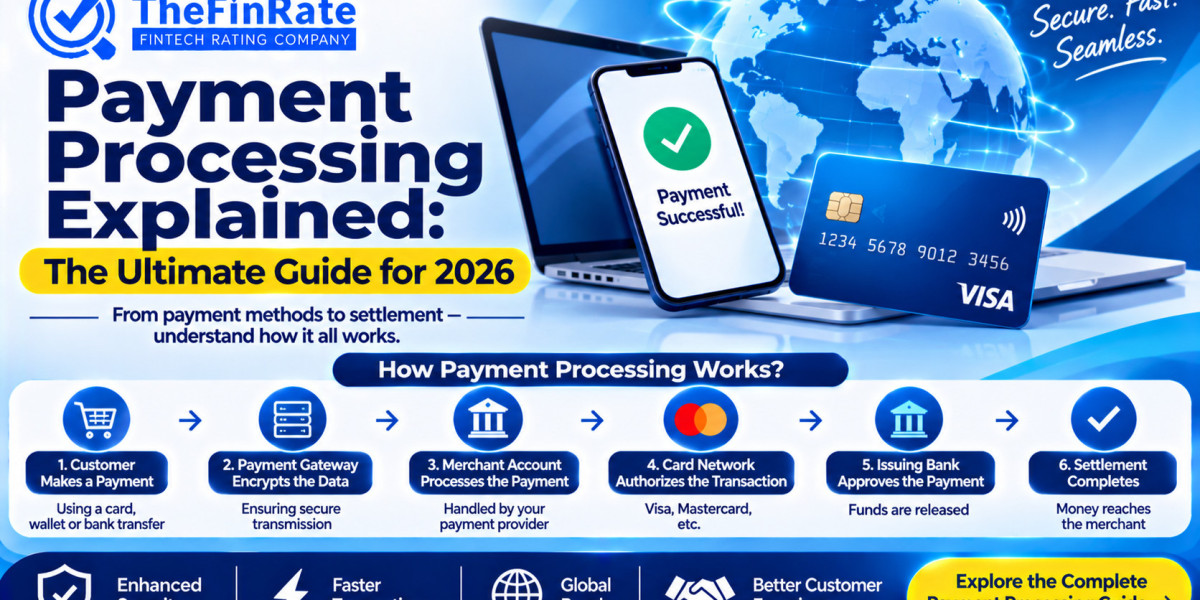

Payment processing is the behind-the-scenes sequence that moves money from a customer’s account to a merchant’s account when someone pays by card, wallet or bank. It takes only seconds at checkout, but it involves several parties, three distinct stages and a stack of fees. This guide explains how payment processing works, who is involved, what it costs and how to choose a provider, with seven widely used processors to compare.
Quick answer
● What it is: Authorizing, clearing and settling a payment between a customer’s bank and a merchant’s bank
● Who is involved: Cardholder, merchant, gateway, processor, acquirer, card network and issuer
● How long it takes: Authorization takes seconds, and funds usually settle in one to three business days
● What it costs: Interchange, card network fees and a processor markup
● Developers and online-first businesses: Stripe
● In-store and online together: Square
● Lower costs as volume grows: Helcim
“Top” here means a strong fit for a defined need based on published features and pricing. It is not a guarantee of performance for your business.
What payment processing is
Payment processing covers everything that happens between a customer choosing to pay and the merchant receiving the money. A payment gateway captures and encrypts the payment details at checkout. A processor routes the transaction to the card network and the issuing bank, and the acquirer, which holds the merchant account, receives the funds on the merchant’s behalf. Many providers bundle several of these roles into one product.
Who is involved in a card payment
- Cardholder: The customer paying.
- Merchant: The business selling the goods or services.
- Payment gateway: Captures and encrypts card data at checkout and passes it on.
- Payment processor: Moves transaction data between the merchant’s side and the card network.
- Acquirer: The merchant’s bank, which holds the merchant account.
- Card network: Visa, Mastercard or another scheme that connects acquirers and issuers.
- Issuer: The cardholder’s bank, which approves or declines the payment.
How a card payment works, step by step
| Stage | What happens | Typical timing |
|---|---|---|
| Authorization | The gateway sends the request through the network to the issuer, which checks funds, fraud signals and authentication, then approves or declines | Seconds |
| Capture | The merchant confirms the sale and the amount to be charged | At sale or shortly after |
| Clearing | Approved transactions are batched and exchanged between acquirer and issuer through the card network | Same or next day |
| Settlement | The issuer sends funds to the acquirer, which pays the merchant, minus fees | Often one to three business days |
Refunds and disputes use the same rails. A chargeback happens when a cardholder disputes a payment with their bank, which can reverse the funds and add fees. Every card transaction has a unique 23-digit code, the ARN, that banks use to trace it. See our guide to how merchants use an ARN to track missing transactions.
What payment processing costs
Fees come in three layers:
● Interchange: Paid to the issuer, and it varies by card type, region and how the payment is taken.
● Card network fees: Paid to Visa, Mastercard or another scheme.
● Processor markup: The provider’s own margin, plus monthly, gateway, PCI, chargeback and refund fees.
A common benchmark for online transactions is about 2.9% plus 30 cents, which is $3.20 on a $100 sale. One 2026 analysis puts a healthy effective rate at 1.8% to 2.4% for card-present businesses and 2.1% to 2.9% for online-first businesses. Use your own statements to check where you sit.
Payment processing pricing models
| Model | How it works | Best for |
|---|---|---|
| Flat rate | One rate covers all costs, simple but costlier at volume | New and small businesses |
| Interchange-plus | Interchange and scheme costs plus a fixed markup, more transparent | Growing volume |
| Subscription | A monthly fee replaces per-transaction markup | Higher volume |
| Quote-based | Negotiated pricing | Enterprise and high-risk accounts |
Payment methods in 2026
● Cards: Still the main method for most online and in-store sales.
● Digital wallets: Apple Pay, Google Pay and PayPal run their own checks and are widely used at checkout.
● Pay by bank and account-to-account: Bank payments through open banking can cost less than cards. In Europe, Wero is building account-to-account rails.
● Stablecoins and crypto: Providers such as Stripe now offer stablecoin checkout for some merchants.
● Real-time payment rails: Instant account-to-account networks continue to expand in many markets.
Offering more than one method can lift conversion and lower costs, but each adds refund, dispute and reconciliation work.
Security and compliance
● PCI DSS: Any business that stores, processes or transmits card data must meet this standard, and using a hosted gateway reduces your scope.
● Tokenization and encryption: Card details are replaced with tokens so merchants do not store raw numbers.
● 3D Secure and strong customer authentication: An extra check for the cardholder. Rules differ by region.
● Fraud and chargeback monitoring: Card networks track dispute ratios, and merchants above thresholds can face fines or account termination.
The top 7 payment processors to know
1. Stripe: best for developers and online businesses
Stripe offers customizable checkout, payment links and invoicing, supports more than 135 currencies, and has no monthly fee or long-term contract. Its published online rate is 2.9% plus $0.30.
● Limits: It does not sell full countertop POS setups, and deposits can take up to two business days
● Suits: SaaS, eCommerce, marketplaces and developer-led teams
2. Square: best for combined in-store and online sales
Square gives you gateway, processing, POS software and hardware in one place. The Free plan has no monthly fee, and there are no termination, chargeback or PCI fees.
● Limits: Free plan rates are higher than many competitors
● Suits: Retail, cafes and service businesses
3. Helcim: best for lower costs at volume
Helcim uses interchange-plus pricing and applies volume discounts automatically as your monthly processing grows. There is no monthly fee and no long-term contract.
● Limits: Deposits may take up to two business days, and costs are harder to predict than flat rates
● Suits: Growing SMBs with steady card volume
4. PayPal: best for wallet-friendly checkout
PayPal is one of the most widely used payment platforms and integrates with most shopping carts. It has no monthly fee and no PCI compliance fee.
● Limits: Deposits may take up to three days, and the product range can be confusing
● Suits: Merchants whose customers expect to pay with PayPal
5. Chase Payment Solutions: best for bank-linked processing
Chase is both processor and acquiring bank, so deposit issues stay with one company. It has no PCI or cancellation fees.
● Limits: Its Business Complete checking account carries a $15 monthly fee for some merchants
● Suits: Businesses that already bank with Chase
6. Adyen: best for enterprise and global scale
Adyen offers global acquiring and risk management on interchange-plus pricing, aimed at larger and multinational merchants.
● Limits: Minimum fees can make it a poor fit for small businesses
● Suits: High-volume enterprises selling in many countries
7. Worldpay: best for larger merchants
Worldpay serves larger merchants that want a custom pricing agreement and enterprise support. Pricing is quote-based, so request a written schedule before comparing it with flat-rate providers.
● Limits: Setup is more involved than self-serve providers
● Suits: Established merchants with significant volume
How to choose a payment processor
- Match your sales channel. Online only, in person or both.
- Pick a pricing model that fits your volume and ticket size.
- Model total cost. Include monthly, PCI, chargeback, refund and early termination fees.
- Check payout speed and holds.
- Review integrations with your cart, POS or accounting tools.
- Look at contract length and cancellation terms.
- Plan for growth. Look at multi-currency support and volume pricing.
Common mistakes
● Choosing on headline rate alone
● Ignoring refund and chargeback costs
● Forgetting that some providers share one merchant account across many merchants
● Locking into a contract before testing
● Overlooking account-hold policies for new accounts
● Letting chargeback ratios drift toward monitoring thresholds
Verdict
Payment processing is simple at checkout and layered underneath. Flat-rate platforms suit simplicity and lower volume, interchange-plus and subscription models suit scale, and enterprise providers suit global operations. Shortlist two or three, request written fee schedules and compare total monthly cost, payout speed and contract terms.
Recent News and Developments in Payment Processing
● September 2025: Fiserv acquired CardFree and completed the purchase of the remaining stake in AIB Merchant Services, strengthening its Clover platform and eCommerce acquiring presence in Europe.
● October 2025: Visa began formal enforcement of its Acquirer Monitoring Program (VAMP) for merchants in the Excessive category.
● April 2026: FIS completed its acquisition of Global Payments’ Issuer Solutions business, leaving Global Payments focused on merchant solutions after its Worldpay deal.
● June 2026: A federal judge granted preliminary approval to a revised Visa and Mastercard settlement with US merchants. Final approval is not expected until late 2026 or early 2027.
Read More:
1. Complete Guide for High-Risk Merchant Account (2026)
2. Top Fintech Companies Around the Globe
3. How Plaid Enables Secure Payments
4. Best Merchant Account Providers in 2026
5. Top 10 Forex Payment Processing Options
6. Is BithoEX.com Safe? Risks and Red Flags
7. Paymentico: What It Is and What to Do
Note: If you require specific details, provider comparisons, or insights that are not currently included in this overview, we are happy to accommodate your request. Please let us know your exact needs, and we will ensure the content is updated accordingly.
About Us:
TheFinRate is a B2B fintech information platform featuring payment provider reviews, comparisons, directories, industry guides, and educational resources. It helps online merchants, eCommerce businesses, SaaS companies, fintech startups, and payment professionals compare providers and make informed payment decisions.
Contact Us:
TheFinRate