
Smart Contract Audit Checklist: 10 Essential Security Checks Before Deployment
Blockchain applications are becoming an important part of modern business, enabling decentralized finance, digital asset management, automated transactions, and Web3 services. Smart contracts make these applications possible by executing predefined instructions directly on the blockchain.
However, even a small coding mistake can create a significant security weakness. Vulnerable functions, incorrect permissions, and insecure external integrations may expose digital assets and affect application reliability.
Before launching a blockchain project, developers should make security a priority. A professional smart contract audit helps identify potential weaknesses, evaluate contract behavior, and reduce security risks before deployment.
This guide covers ten essential security checks that businesses and developers should consider when preparing smart contracts for production.
Why Is a Smart Contract Audit Important Before Deployment?
Smart contracts often control valuable operations, including token transfers, financial transactions, user permissions, and digital asset ownership.
Once deployed, modifying a contract may be difficult or require carefully designed upgrade mechanisms. This makes pre-deployment security testing particularly important.
A professional smart contract security audit helps developers examine contract logic, identify vulnerabilities, and understand how the application may behave under unexpected conditions.
An audit can help organizations:
Identify security weaknesses before launch.
Protect digital assets and transactions.
Review access controls and permissions.
Detect potentially exploitable code.
Improve contract reliability.
Support safer blockchain deployment.
10 Essential Smart Contract Security Checks
1. Review Access Control Mechanisms
Access control determines who can execute sensitive contract functions. Developers should ensure that administrative operations, ownership transfers, and configuration changes are restricted to authorized users.
Poor permission management can allow unauthorized individuals to modify contract settings or perform restricted operations.
2. Check for Reentrancy Vulnerabilities
Reentrancy occurs when an external contract call allows an attacker to re-enter a vulnerable function before the original execution is completed.
Developers should review external calls, transaction sequencing, and protective mechanisms to reduce this risk.
3. Validate Input Data
Smart contracts should handle user inputs carefully. Incorrect validation may allow unexpected values or invalid transaction parameters to affect contract behavior.
Input validation helps ensure that functions operate within their intended conditions.
4. Review Arithmetic Operations
Financial calculations, token balances, and transaction amounts require careful handling.
Developers should examine calculations for unexpected values, precision problems, and incorrect assumptions about numerical limits.
5. Examine External Contract Interactions
Many blockchain applications interact with external protocols, token contracts, and other services.
These integrations may introduce additional security risks. Developers should review external dependencies and understand how failures or unexpected responses could affect contract execution.
6. Evaluate Oracle Security
Contracts that depend on external price feeds or market data need reliable oracle mechanisms.
Weak oracle designs may allow manipulated data to influence financial operations or contract decisions.
7. Review Transaction Logic
Every important transaction function should be examined to ensure it behaves as intended.
This includes token transfers, withdrawals, deposits, rewards, and payment operations. Incorrect logic can produce unexpected results or expose assets to unauthorized access.
8. Test Error Handling
Contracts should respond safely when transactions fail or unexpected conditions occur.
Developers should examine how functions handle invalid inputs, failed external calls, and insufficient balances.
9. Examine Upgrade and Administrative Functions
Upgradeable contracts require carefully controlled administrative mechanisms.
Reviewing upgrade permissions, ownership management, and administrative functions helps reduce the risk of unauthorized modifications.
10. Review Events and Transaction Records
Events provide information about important contract activities. Developers should verify that relevant operations generate appropriate events and that transaction records support monitoring and troubleshooting.
These ten checks provide a useful starting point, but a complete security assessment should also consider the contract's architecture, dependencies, and specific business requirements.
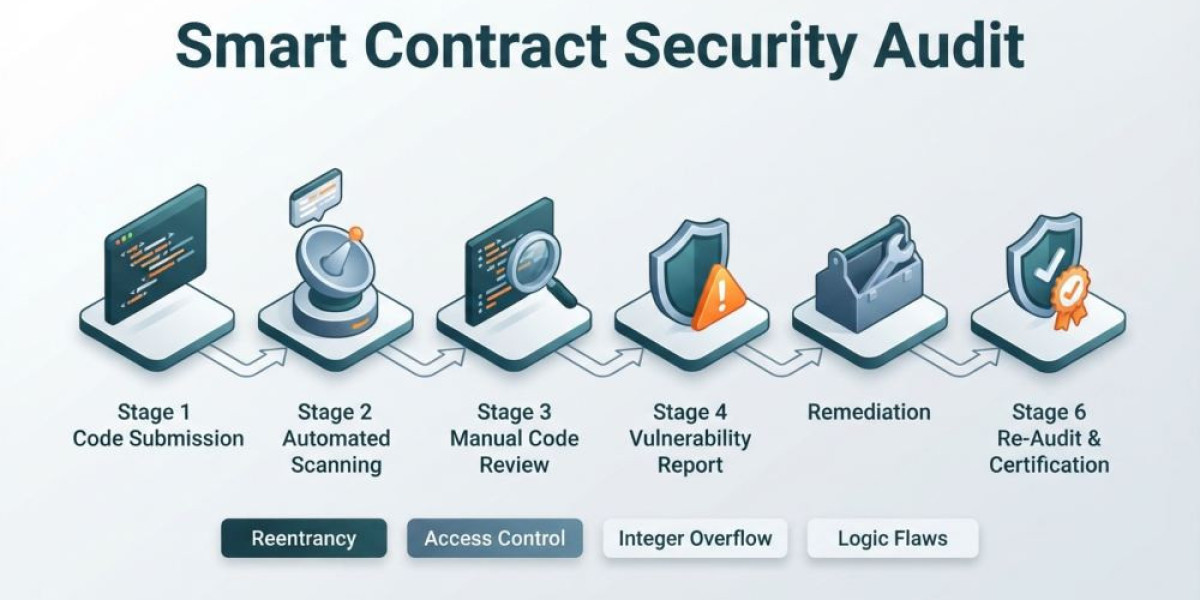
Manual Code Review vs. Automated Security Testing
Smart contract security reviews often combine manual analysis with automated testing techniques.
Manual Code Review
Manual review allows security professionals to examine contract logic, identify insecure implementation patterns, and understand potential weaknesses that automated tools may not fully interpret.
Automated Security Testing
Automated tools help identify known vulnerability patterns, examine code behavior, and detect potential security issues more efficiently.
Combined Approach
Using both approaches provides broader coverage. Automated testing supports vulnerability discovery, while expert analysis helps validate findings and understand their potential impact.
Neither approach should be treated as a complete replacement for the other.
What Happens After a Smart Contract Audit?
Identifying vulnerabilities is only one part of the security process. Development teams must also understand the findings and take appropriate corrective action.
A typical remediation process includes:
Review Findings: Understand the identified security weaknesses.
Prioritize Issues: Focus on vulnerabilities according to severity and potential impact.
Implement Fixes: Update contract code and address reported weaknesses.
Retest Changes: Verify whether the implemented fixes resolve the identified issues.
Prepare for Deployment: Review the final contract version before production release.
A structured remediation process helps development teams address security issues more effectively.
Common Mistakes to Avoid During Smart Contract Development
Even experienced development teams can overlook security issues when projects prioritize functionality and deployment speed.
Common mistakes include:
Relying entirely on automated scanning tools.
Using complicated contract logic without sufficient testing.
Implementing weak administrative permissions.
Ignoring external contract dependencies.
Deploying without reviewing critical functions.
Making major updates without additional security testing.
Treating an audit as a guarantee of complete security.
Avoiding these mistakes can help organizations build more reliable blockchain applications.
How FemtoSec Supports Smart Contract Security
Smart contract security requires a structured approach that considers code quality, application functionality, and potential attack scenarios.
FemtoSec provides smart contract auditing services to help organizations identify potential security weaknesses and strengthen their blockchain applications.
A professional audit can help businesses understand security findings, prioritize remediation, and make informed decisions before deploying smart contracts.
Whether you are developing a decentralized finance platform, launching a token, or building an NFT marketplace, security testing should be an important part of your development process.
Explore FemtoSec Smart Contract Auditing to learn more about improving blockchain application security.
Conclusion
Smart contract security should never be an afterthought in blockchain development. A vulnerable contract can expose digital assets, disrupt transactions, and affect user confidence.
Following a structured security checklist and conducting a professional smart contract audit helps developers identify weaknesses before deployment and make better security decisions.
By combining secure coding practices, automated testing, expert analysis, and effective remediation, businesses can build stronger blockchain applications.
Make security part of your blockchain development strategy with FemtoSec. Visit our Smart Contract Auditing Services page to learn how to strengthen your smart contract security
Frequently Asked Questions
1. What should be checked during a smart contract audit?
An audit may examine access controls, reentrancy risks, arithmetic operations, external integrations, oracle security, transaction logic, and contract permissions.
2. When should developers conduct a smart contract audit?
Ideally, an audit should be performed before deployment. Additional reviews may be necessary after significant code changes or new integrations.
3. Are automated tools enough for smart contract security?
Automated tools help identify known vulnerability patterns, but manual analysis is also important for evaluating complex contract logic and validating findings.
4. Can a smart contract audit prevent all blockchain attacks?
No. An audit helps reduce security risks, but it cannot guarantee protection against every possible vulnerability or future attack.
5. What happens if vulnerabilities are discovered?
Developers should review the findings, prioritize issues, implement corrective changes, and arrange appropriate retesting.
6. Which blockchain projects need smart contract auditing?
DeFi applications, cryptocurrency tokens, NFT marketplaces, decentralized exchanges, DAOs, and other blockchain projects using smart contracts can benefit from security audits.