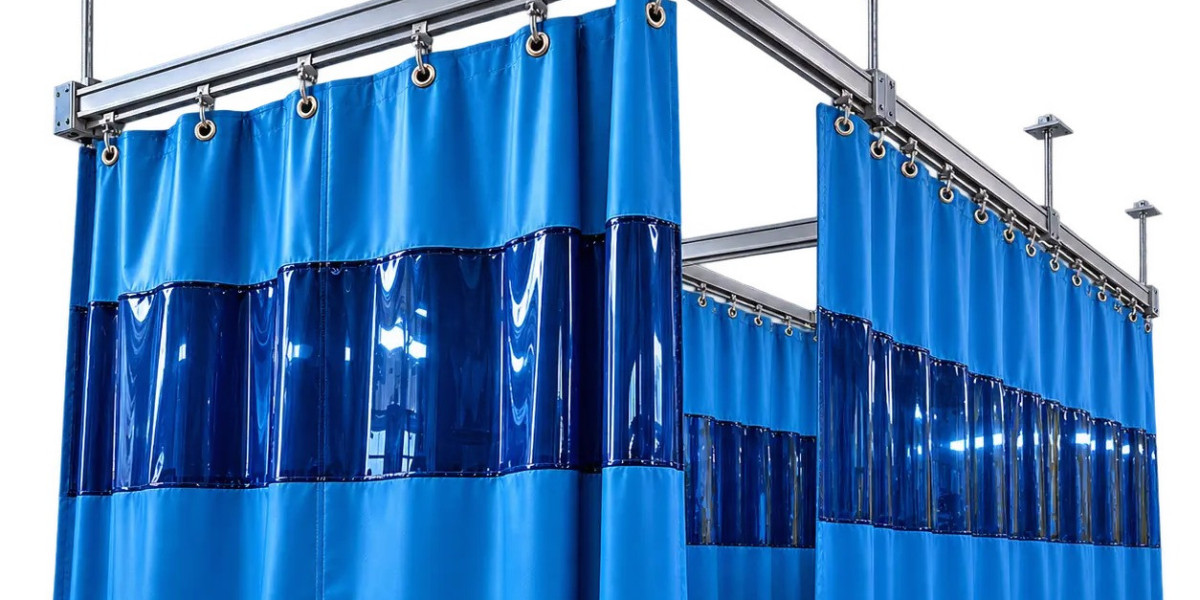

Acoustic curtains are heavy, multi-layer textile barriers used to control noise by absorbing sound energy and limiting its spread across a space. They are specified for test labs, production floors and equipment rooms, and their performance is judged against standards such as ISO 354, ISO 11654, ASTM C423 and ASTM E90, alongside occupational limits like OSHA 1910.95 and EU Directive 2003/10/EC.
The terms “acoustic” and “soundproof” are often used interchangeably in purchasing documents. They describe different performance goals, and confusing them is a common reason a noise-control installation underdelivers.
What the Terms Actually Mean
“Acoustic” comes from the Greek akoustikos, meaning “of hearing.” In engineering it covers how sound behaves in a space. “Soundproof” is a more absolute term, implying that sound is fully prevented from passing through a boundary.
In practice, acoustic curtains manage sound within and around a space (absorption and attenuation), while soundproof curtains aim to block sound from passing between spaces (transmission loss).
No curtain is truly soundproof. Even the densest products reduce noise by a defined number of decibels rather than eliminating it, which is why datasheet values matter more than product names.
A Plain-Language Analogy
Imagine shouting in a large, empty room. You hear the echo because sound bounces off hard walls and returns to your ears. Hang thick drapes or place soft furnishings in the room and the echo fades, because the sound is absorbed instead of reflected. That is the job of an absorbing curtain.
Now imagine shouting in the same room while someone stands outside the door. If you want them not to hear you, soft furnishings will not help much. You need mass and an airtight seal, like a solid wall. That is the principle behind blocking curtains.
Where They Are Used
Automotive, aerospace, medical devices, telecom, consumer electronics, industrial manufacturing and data centers all use curtain-based noise control, often for different reasons. An automotive NVH lab needs reduced reverberation around a test rig. A medical equipment manufacturer may need to keep a noisy compressor test from disturbing an adjacent clean area.
Different standards drive different configurations. Workplace exposure rules push for lower reverberant noise levels on the floor, while product-noise testing and customer specifications may require a measured transmission loss or a controlled background level. The same facility can therefore need both absorptive and barrier-type products.
Types and Common Uses
Common configurations include absorptive wall-mounted curtains, mass-loaded barrier curtains, partition curtains for test cells, machine enclosure curtains, sliding or track-mounted curtains for access areas, and temporary curtains for retrofit or maintenance work. Absorptive types suit reverberation control. Barrier types suit isolating a noise source or protecting a quiet zone. Track-mounted systems are popular where operators or equipment need frequent access.
Standards and Typical Specifications
Absorption is measured in a reverberation room under ISO 354 or ASTM C423, and summarized as a Noise Reduction Coefficient (NRC) or weighted absorption coefficient (αw per ISO 11654). Absorptive curtains typically reach NRC values of roughly 0.4 to 0.9, depending on fabric weight, backing and how loosely they are draped.
Transmission loss is tested under ISO 10140 or ASTM E90 and reported as STC (ASTM E413) or Rw (ISO 717-1). Mass-loaded barrier curtains commonly fall around STC 20 to 32, which is a meaningful reduction but well below a masonry wall.
Other specs worth checking include fire performance (for example EN 13501-1 or ASTM E84), temperature range, and the frequency range over which values are quoted, typically 125 Hz to 4 kHz. Low-frequency performance below 250 Hz is usually the weakest point of any textile solution.
HOW ACOUSTIC CURTAINS WORK: ABSORPTION VS TRANSMISSION LOSS
Absorptive curtains rely on porous, fibrous layers that convert sound energy into small amounts of heat as air moves through the material. Draping the fabric with 100 to 200 percent fullness, and leaving an air gap behind it, improves absorption, especially at mid and low frequencies.
Barrier curtains rely on mass and limp, dense layers such as loaded vinyl composites. Their benefit comes from sound being reflected or dissipated as it tries to move the material. Combined products pair a dense barrier with an absorptive face, giving both functions in one layer.
Practical tip: Gaps cause more performance loss than material choice. Leaks at the floor, edges and overlaps can cut real-world attenuation by several decibels, so specify overlapping seams and sealed or weighted hems, and verify with an on-site sound level measurement after installation.
Need Help Choosing?
Are you in the process of installing or choosing acoustic curtains, sound proof curtains, sound dampening curtains, noise cancelling curtains, noise reducing curtains, sound blocking curtains, sound deadening curtains or sound absorbing curtains? Don’t hesitate to contact us. Our account managers and acoustic experts can help even if you are not yet sure what you need, whether that is a datasheet comparison, a site assessment or a specification review.