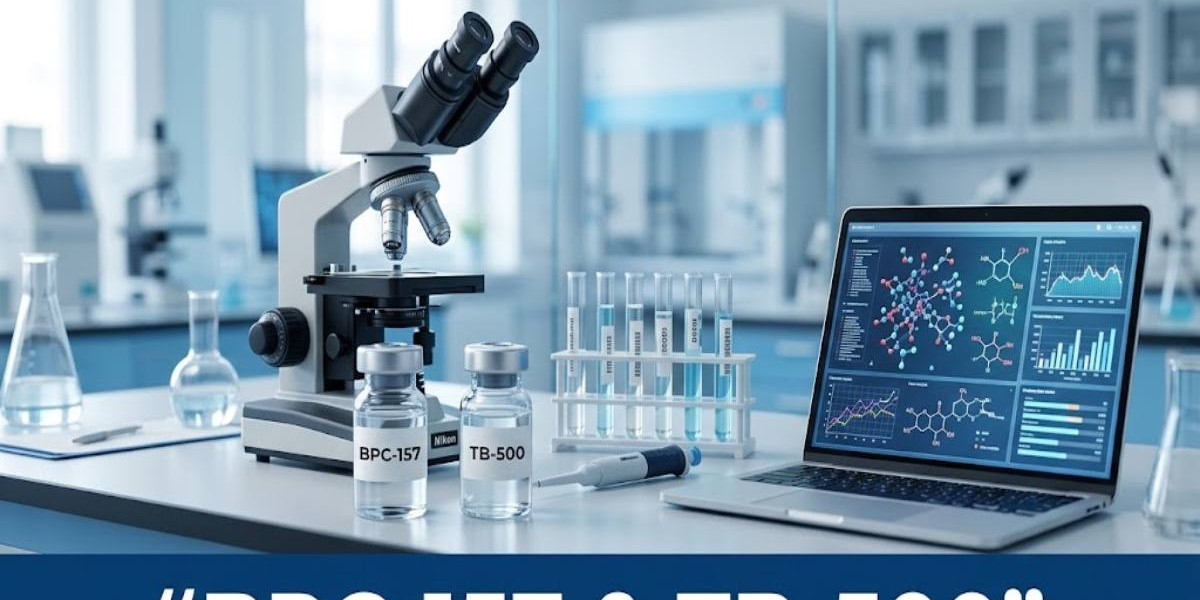

What Are These Two Peptides?
Peptides are short chains of amino acids, and scientists use them as small, precise tools to study how cells communicate. Two names appear again and again in tissue-repair discussions, and the pairing bpc157 tb500 is how many suppliers and forums label them together. One is a 15-amino-acid fragment inspired by a protein in gastric juice, while the other is a synthetic fragment related to thymosin beta-4. Neither is an approved medicine, so this guide treats them strictly as laboratory research compounds.
Quick Answer for Voice Search
BPC-157 and TB-500 are synthetic peptides studied in animal and cell models for tissue-repair pathways. They are not FDA-approved drugs and are sold only for laboratory research. Human evidence is very limited, so they should never be used as self-treatment.
Where Each Peptide Comes From
The origin story helps students remember the difference between the two molecules. BPC stands for Body Protection Compound, and the sequence was first studied in connection with stomach-lining protection. Looking at bpc157 and tb500 side by side shows two different starting points, one gastric and one linked to a protein found inside many cell types. Because both sequences are short, laboratories can synthesise them and check purity with standard analytical chemistry.
Thymosin Beta-4 Background
Thymosin beta-4 is a 43-amino-acid protein that helps regulate actin, the scaffolding inside cells. Actin controls how cells change shape and move, which matters in wound-healing models. TB-500 is generally described as a synthetic fragment based on the active region of this protein, although supplier descriptions vary.
What Do Laboratory Studies Examine?
Researchers choose models that isolate one question at a time, such as how fast cells close a gap or how new capillaries form. A careful protocol states the species, injury type, dose range, timing and measured outcome. Reading about tb500 bpc157 in a paper means checking whether the study had a vehicle-only control group, since that is what lets results be credited to the compound. Without that control, a promising result is only an observation, not evidence.
Rodent tendon and ligament injury models
Cell migration (“scratch”) assays
Angiogenesis assays that track new blood-vessel growth
Gastrointestinal lining models
A Simple Classroom Example
Imagine a student scrapes a thin line through a dish of cultured cells and photographs the gap at hour zero. One dish receives a test peptide and another receives plain buffer, and both are photographed again after a day. The difference in how much each gap has closed is the measurable result, and no person or patient is involved.
What Does the Evidence Really Show?
The published literature is real but narrow, and most of it is preclinical. Pavel Sikiric and colleagues in Croatia have authored many BPC-157 reviews, while Goldstein and co-authors summarised thymosin beta-4 biology in 2012. A fair reading of bpc157/tb500 research shows interesting animal signals but almost no large, controlled human trials. Good scientists therefore say that “promising in a rat or a dish” does not mean “proven in people.”
Limits Worth Remembering
Many BPC-157 papers come from one research network, so independent replication is limited. Doses, purity and study design differ between papers, which makes direct comparison hard. Anyone reviewing the literature should keep animal findings and human findings in separate columns.
Safety, Regulation and Compliance
Honesty matters more than hype in this field. The FDA has previously listed BPC-157 among bulk drug substances with significant safety questions, which restricts compounding, and that status can change, so check current guidance. The World Anti-Doping Agency prohibits both substances, so competitive athletes risk sanctions. When you see bpc157 / tb500 claims on social media, treat them as marketing rather than medical evidence.
What “Research Use Only” Means
A research-use-only label means a product is sold for laboratory work, not for diagnosing, treating or preventing disease. It is a legal category, not a safety certificate. Rules vary by country and change over time, so always confirm the current position.
Choosing a Reliable Laboratory Supplier
Purity and paperwork are the two practical questions in any laboratory purchase. Reputable suppliers publish batch-specific analysis, and a lab should verify those records instead of trusting a banner on a website. A buyer comparing vials of bpc157/tb500 should look for HPLC purity and mass-spectrometry identity results tied to a specific lot. Peptides also degrade with heat, light and moisture, so storage and shipping practices matter as much as the number on the label.
Batch-specific certificate of analysis (COA)
Lot number and manufacture date
Cold-chain or desiccated shipping
Clear “for research use only” labelling
Storage Basics
Freeze-dried powder is generally kept cold, dry and away from light. A vial of tb500 bpc157 left on a warm windowsill would degrade, and any result from it could not be trusted. Once dissolved, peptides lose stability quickly, so labs follow written supplier guidance.
Common Mistakes Beginners Make
New students often treat an animal result as if it were a human result. Another frequent error is trusting testimonials, which are stories rather than controlled data. Mixing up bpc157 and tb500 is also common, because they are different molecules with different origins and are studied separately. Finally, many beginners forget that a bpc157 / tb500 product page is advertising, not medical guidance.
Final Thoughts
Learning this topic is mostly about learning to read evidence calmly. The combination bpc157 tb500 is a useful teaching case because it shows how promising preclinical signals can be overstated online. Keep the sources, the species and the limits in view whenever you read a claim. If you have a personal health concern, speak with a licensed physician instead of a supplier.
Frequently Asked Questions
Are these peptides approved by the FDA?
No. Neither compound is approved as a medicine for human use. Suppliers sell them only for laboratory research.
Can athletes use them?
No. Both substances appear on the World Anti-Doping Agency’s prohibited list. A positive test can lead to a suspension, so athletes should avoid them.
Is there strong human evidence?
Not yet. Most findings come from animal or cell studies, and large controlled human trials are lacking. Medical questions belong with a licensed physician.
How is peptide purity checked?
Laboratories commonly use HPLC to measure purity and mass spectrometry to confirm identity. These results should appear on a batch-specific certificate of analysis. A missing or generic certificate is a warning sign.